
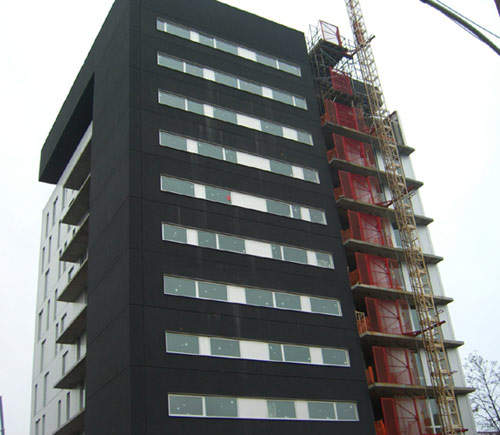
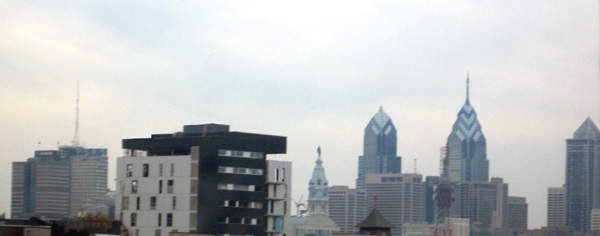
From certain vantage points, the asymmetrical American Loft Building commands attention on the Philadelphia skyline in Pennsylvania, US. In this exercise in bold geometry, the residential structure consists of interlocking, L-shaped sections of black and grey which contrast in a striking way. The L-shapes don’t fit together neatly but rather culminate in a multilevel roof.
Rising 11 storeys and 119ft above North American Street, the 38-loft building towers over two and three-storey structures in Northern Liberties, a semi-industrial neighbourhood.
Recommended White Papers

Recommended Buyers Guides

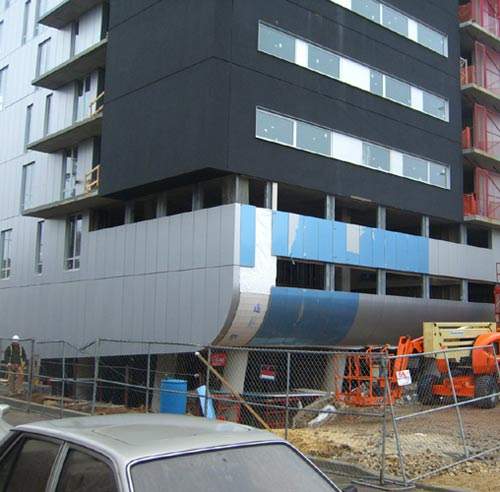
But the building, by architect Winka Dubbeldam of New York City’s Archi-Tectonics, looks most distinctive close to the ground, because the sloped base appears to hover in the air.
The building occupies 13,500ft2 and offers an area of 61,000ft2. It was constructed from January 2007 to March 2008. Creating Real Estate Innovations (CREI) was the developer of the $15.1m project. It was purchased by Parkway Corporation in July 2010 for $10.7m with finance from Abington Bank. The company planned to rent the apartments rather than sell the condos.
American Loft Building design
This aspect came in response to a major design challenge. The zoning envelope mandated that the structure stand on concrete columns over an open parking area. With ground-level parking, passers-by would have glimpsed unattractive views of cars, rather than feeling any sense of connection to the building.
Dubbeldam, therefore, sloped the parking area. Cars enter the space at street level, proceeding downhill until they’re one storey below ground. As they go, they pass over a grassy carpet sprouting from porous pavers. Dubbeldam thought greenery would make the concrete look friendlier.
To provide vehicle clearance, the bottom of the building is sloped, using the same angle as in the parking lot. In the lobby, this slope translates into a ramp and steps.
Also for the sake of clearance, the bottom of the building curves up into a rounded edge over the vehicle entrance. An Alucobond exterior made this possible, as the insulated aluminium panels can bend. Once again, the curve translates into the interior, the living rooms of two split-level townhouses feature concave concrete walls with built-in benches.
Because of the irregular bottom plane, the building might appear as if it’s listing, a sailboat heeling in light wind. But this is an illusion, because the structure rises straight to the sky.
From top to bottom, the building has a floating quality. For instance, in the parking area, the concrete columns are recessed and angled, making them less visible from the exterior. At the top of the building, a glazed curtainwall makes it look as if the uppermost story rests only on glass. The construction used green materials for sustainability and requires low energy and maintenance.
Interiors of the asymmetrical American Loft Building in Pennsylvania
The 40-unit American Loft Building has two duplex apartments at the first and second levels and offers one, two and three bedroom flats.
Intent on avoiding the monotonous repetition typical of large buildings, Dubbeldam lent variety to the interior and exterior in a number of ways. First, she designed the open-plan lofts to be different from each other. There are two to six units on each floor, and some span floors. That made it challenging to find a space for the shafts extending through the building.
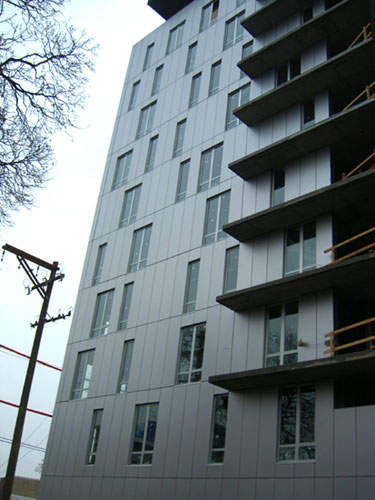
Irregularly positioned, the tall, thin one and two-light windows bring different amounts of light into each flat. They also make the grey façade resemble a punch card used in a voting machine or in a 1960s computer.
Exterior design features
Rather than being monolithic or monochromatic, the exterior features the interplay of light grey and jet black.
These hues, as well as multiple materials, exist on different planes. Grey aluminium (which reflects the shifting sky) appears to fit hand-in-glove with the deep black natural plaster. Yet they never meet. A curtain of glass hangs between them, both joining and separating the dominant parts of the façade.
Large cantilevered balconies with glass railings jut out from every unit, creating a sense of additional depth. The prefabricated façade panels, made of exterior insulation finishing system (eifs) or alucobond, are held by an insulated stud wall which is strengthened by slab edges.
Contractors involved in the iconic building project
The architect of record for the project was Zimmers Associates. WSP Cantor Seinuk was the structural engineer, BHG Consultants was the mechanical, electrical, plumbing contractor and fire protection consultant engineer.
McClymont & Rak Engineers provided the geotechnical services. Ambric Technology was the civil engineer. Creative Construction Managers provided the construction management services. Facade Technology was the façade consultant.