
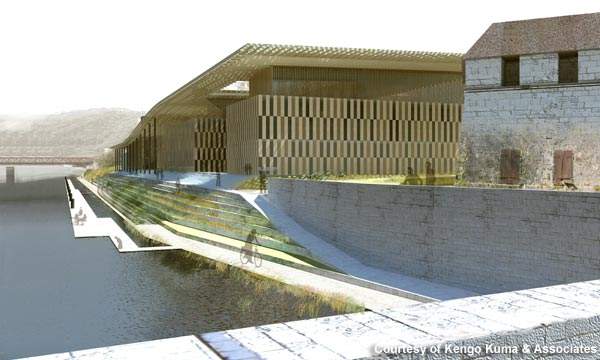
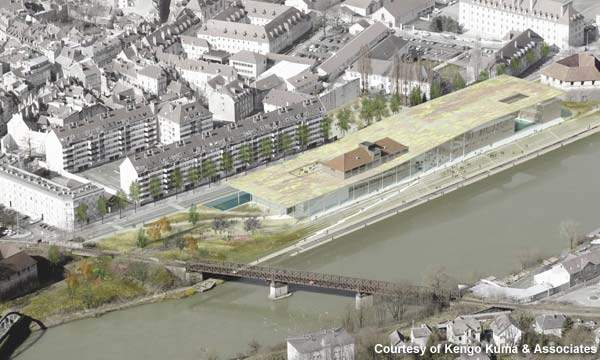
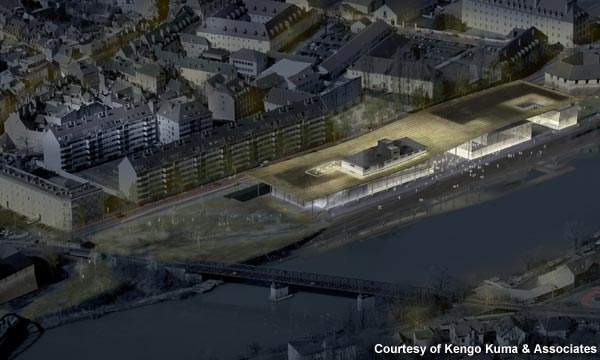
Besançon, the capital of the eastern Franche-Comté region of France, witnesses the confluence of art and music in the new Cité des Arts de Besançon (City of Arts and Culture). Incorporating the Fonds Régional d’Art Contemporain (FRAC) and the Conservatoire à Rayonnement Régional (CRR), the Besançon City of Arts and Culture was designed by Kengo Kuma & Associates from Japan.
With an area of 11,390m², the €49m cultural centre is inspired by the seven hills, the Vauban fort and the Doubs River that surrounds the city. Conceived as a union of the city and its history, the architecture reflects the natural environs and the city.
Recommended White Papers

Recommended Buyers Guides

The project was supported by the ministry of culture, the department (DRAC Franche-Comté) and the General Council of the Doubs. It has 80 classrooms, a new 290-seat auditorium, two showrooms and a conference room. It also features a resource centre, a coffee brewer and a bookstore.
Besançon cultural centre timeline
On 4 July 2007, after competitive bidding between four architecture firms, Kengo Kuma & Associates was awarded the project by a jury that consisted of representatives of the owners of the region, city, Grand Besançon and the ministry of culture, as well as prominent architects from the Franche-Comté region.
On 20 September 2007, the City of Arts and Culture was launched in presence of Raymond Forni, president of the region of Franche-Comté, Jean-Louis Fousseret, the mayor of Besançon, and Kengo Kuma.
Construction of the facility began in May 2010 and was completed in the first quarter of 2013. The cultural centre was opened to the public in April 2013.
Besançon City of Arts and Culture
Fashioned as one of France’s finest villes d’art (art cities), Besançon is renowned for its historical architecture and contemporary art galleries, housing some of the finest art in the country outside Paris.
The project sits on a 2ha brownfield site at the foot of the Citadel of Vauban. Traditionally one of the strongest forts built on a summit, the citadel is bound by cliffs on one side and the Doubs River on the other, complementing the bulwark.
The project intends to overcome the traditional barrier between Besançon and the Doubs with architecture that accentuates the harmony between land, hills and the river.
Culture centre structure
The roof comprises glass panels, aluminium, screen printing and stone elements, with pixellated layers and colour graduations creating the opacity and transparency of the roof. The idea for the pixels is from the traditional pattern of ichimasu, a centuries-old draughtboard pattern that adorns Japanese textiles.
The foyer of the museum is transparent, while other areas are protected by opaque walls, dressed in stone cladding or wood.
The cultural centre used the Chailluz stone, beech and pine from the local landscape. Since its inception in 1982, the FRAC has maintained contemporary art collections that include the works of hundreds of artists. It also features art and design exhibitions. The new structure wraps the old brick warehouse, creating a glassed-in box. It is used as an exhibition gallery for the FRAC. The Conservatoire, considered introvert by the architect, is wrapped with a light layer made of glass and wood panels.
Sustainability
The building design has minimal impact on the environment. The roof is fitted with 1,300m² of photovoltaic cells for producing solar energy. The large open windows reflect natural light and allow cross ventilation. The building is expected to consume energy of 65kWh/m² a year.
The roof structure of the top floor, the framing and the walls are insulated by materials such as wood. A natural renewable system provides air-conditioning to the building. Rainwater is collected, purified and re-oxygenated before being discharged into the river.