
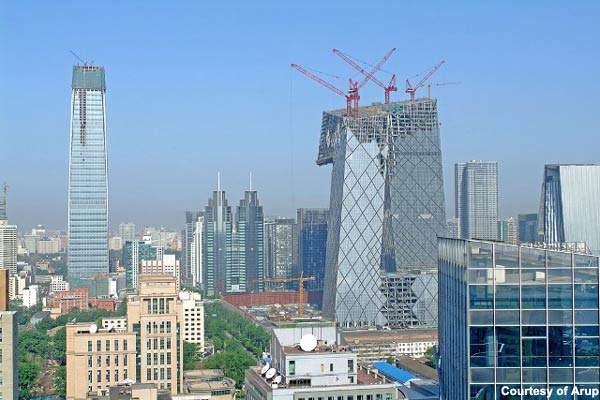
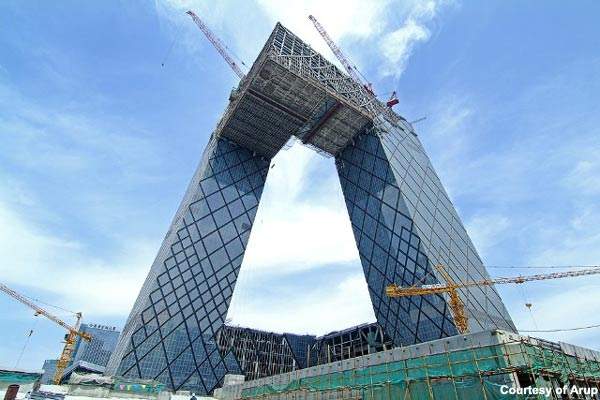
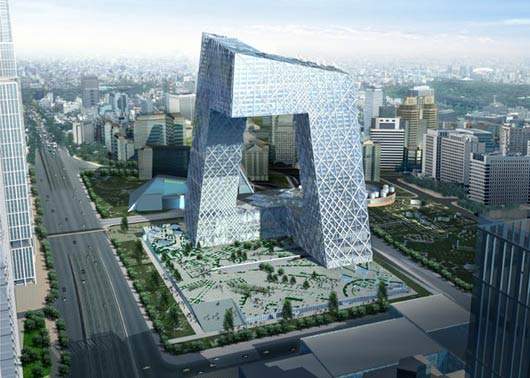
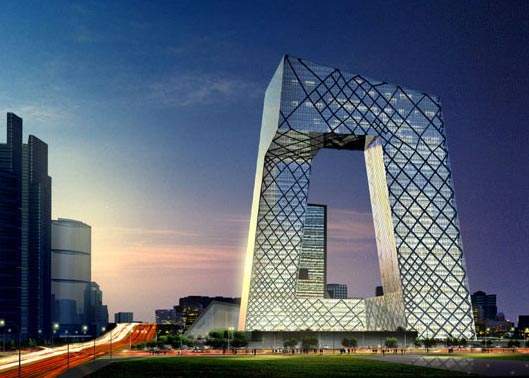
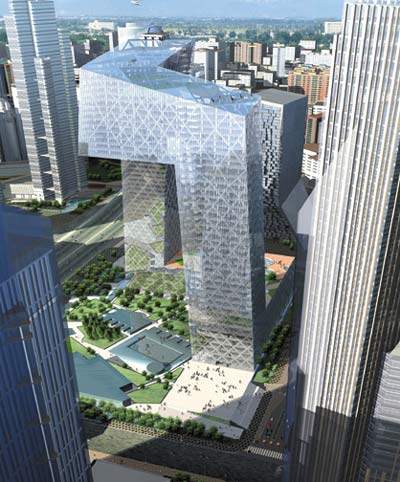
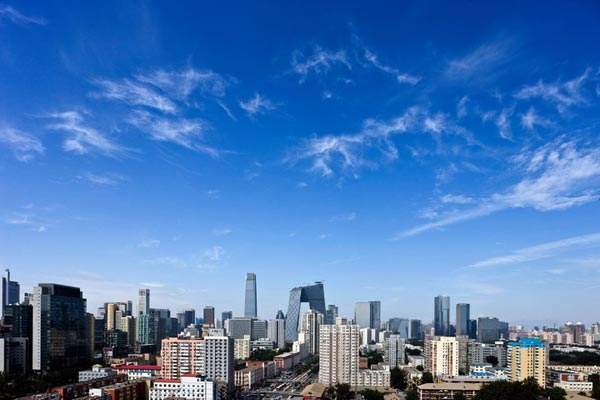
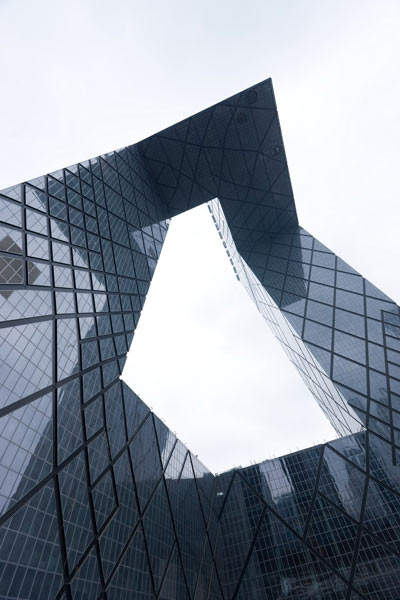

The new headquarters of China Central Television (CCTV) is an iconic anti-skyscraper that, along with other masterpiece designs delivered in time for the 2008 Beijing Olympics, has changed the architectural image of China’s capital city.
The facade of the leaning conjoined towers was completed before the Games, for which CCTV was the official broadcaster, and a number of spaces inside the building were opened to host televised events.
Recommended White Papers

Recommended Buyers Guides

The CCTV building was originally slated to open in October 2009, however, the construction and opening were delayed due to a fire accident in February 2009. The incident resulted in estimated damages worth $23.4m.
China Central Television (CCTV) Headquarters development
Refurbishment work on the burnt, incomplete north wing of the CCTV building began in March 2010. The facelift project comprising two phases included the removal of the ruins and reconstruction of the new wing.
The building was constructed on a 10ha site adjacent to the Third Ring Road in Beijing in the new Central Business District. The project resumed in March 2003 following a review of the design by a panel of Chinese experts. The review was necessary because the ground-breaking design was in contravention to the city’s existing building codes. Construction began in September 2004.
The development was undertaken by the Chinese government as part of a plan to redevelop central Beijing with innovative and functional architecture while preserving historic buildings.
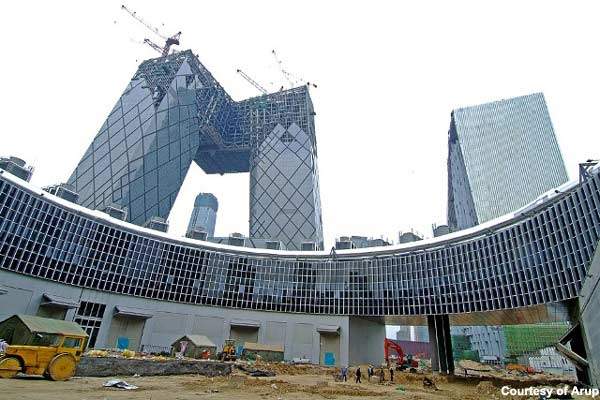
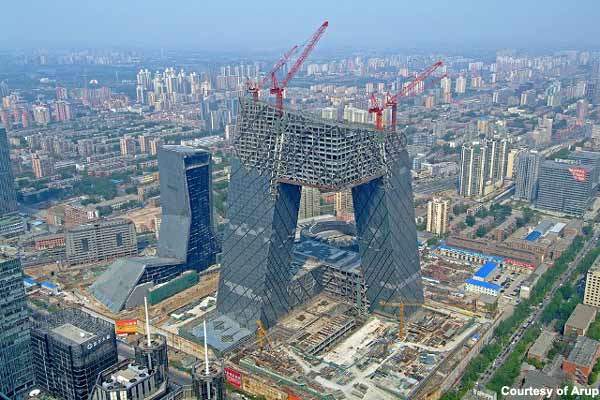
The CCTV building includes two L-shaped high-rise towers which were linked at the top and the bottom at an angle to form a loop, which is described as a ‘Z criss-cross’, a ‘twisted doughnut’ and ‘the pants’. The linking level features 4m-wide glass floors allowing visitors to peer down a 162m drop.
Adjacent to the loop is an additional tower, called the Television Cultural Centre (TVCC). The $732m TVCC building was scheduled for opening in early 2010 but was delayed because of the fire accident. The total construction cost of both buildings has been estimated at €850m ($1.2bn).
CCTV building design
The building was co-designed by Rem Koolhaas and Ole Scheeren of the Office for Metropolitan Architecture (OMA) following a design competition organised by Beijing International Tendering Company, which ended in December 2002.
Ten companies entered the competition including Dominique Perrault, Kohn Pederson Fox and Skidmore, Owings and Merrill LLP, Toyo Ito & Associates, FCJZ of Beijing, East China Architecture and Design Institute of Shanghai (ECADI) and OMA.
The international jury, which included architect Arata Isozaki and critic Charles Jencks, narrowed the competition to three designs by Toyo Ito & Associates with FCJZ of Beijing, East China Architecture and Design Institute and OMA.
In October 2007, OMA was presented with an award at the Cityscape Architecture Review Awards Gala in Dubai, UAE, for the CCTV headquarters in the mixed-use category.
CCTV towers
The tallest CCTV tower is 234m high with a floor area of 465,000m² and consists of a series of horizontal and vertical sections, which establish it as an earthbound structure and not a ‘skyscraper’. This tower comprises administration, news, broadcasting, studios, programme production areas, staff facilities and parking. A public media museum is located on the cantilevered part of the building.
The neighbouring TVCC tower is 194m high with 95,000m² floor space. Its programme includes a 300-room Mandarin Oriental hotel designed by Lim, Teo & Wilkes (containing two restaurants, a suspended champagne sky bar and a ballroom surrounded by water), a visitor centre, a 1,500-seat public theatre, a digital cinema and exhibition and conference facilities.
The remainder of the site surrounding the building was developed into a media park with outdoor filming areas, theatres, production facilities and public entertainment areas.
CCTV contractors and construction
Arup (East Asia and European divisions) was the civil engineering contractor for the CCTV headquarters project. The company was responsible for the structural and mechanical engineering of the structure. It provided security consultancy services, risk analysis and design of the building’s security systems.
OMA formed a design team to continue work on the building, which included the ECADI (as a domestic partner required under Chinese tender regulations), Qingyun Ma of Shanghai as strategic advisors and Arup. ABB installed 67 transformers and 90 UniGear ZS1 air-insulated switchgear units to power the building.
“The tallest tower is 234m high and has a floor area of 465,000m².”
Japan’s Lighting Planners Associates (LPA) served as the lighting designer for the project, while DMJMH+N was contracted as the design consultant. The curtain walling was the remit of the Front of New York. The broadcast design was carried out by ECADI and Sandy Brown Associates of London. The acoustics were designed by Dorsser Blesgraaf of Eindhoven, the scenography by DuckS Sceno of France and the vertical transportation was provided by Lerch Bates & Associates of London.
Structural challenges
The structure of the CCTV building presented a challenge to engineering contractors Arup. The company designed a plan to construct the two 6° leaning towers bent at 90° at the top and bottom to meet, forming a continuous loop. The building was constructed in two tower sections that were then joined to complete the continuous loop on 26 December 2007.
The engineers had to consider the building’s stability at each different phase of construction and designed a braced tube structure to support the leaning towers during their development before they were connected and balanced off each other.
The towers were constructed at opposite diagonal corners of a 160m by 160m footprint, linked by an L-shaped nine-storey podium with three underground floors. The elements were then joined at the top (51 storeys high) by an L-shaped bridge opposite the podium. The tower footprints are 40m by 60m and 52m by 42m. Thin concrete cores inside the building support the internal floors.
Diagrid exoskeleton
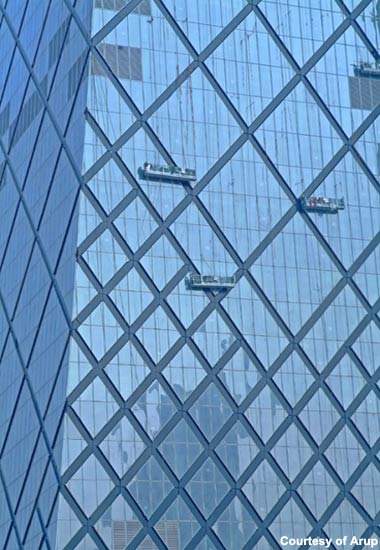
A diagrid ‘exoskeleton’ system was adopted on the external faces of the building to give a tube structure that resists gravity and other lateral forces. The positioning of the columns and diagonal tubes reflects the distribution of forces in the surface skin of the building.
The columns of the diagrid have the same exposed width, but the depth varies according to the load while the diagonals are all 1m by 60cm plate girders, with only the steel thickness varying. A butterfly plate links perimeter columns, braces and beams. The irregular geometry of the steel structure facade gives it stability to cope with different load conditions.
Seismic requirements
The CCTV project was developed with strict adherence to seismic requirements. The building can withstand intensity 8 with a peak ground acceleration of 0.2g.
Arup ran an advanced non-linear computer simulation, the OASYS Dyna application, to determine the effects of a seismic shock on the building’s 40,000 structural elements.
Beijing Geotechnical Institute also collaborated on the earthquake resistance part of the design, as well as surveying the site for groundwater levels.
CCTV building dimensions
The CCTV building has 465,000m² of floor space. Administration and programme offices occupy d 75,000m² and 65,000m² while news production (70,000m²), broadcasting (40,000m²), programme production (120,000m²), staff facilities (30,000m²) and parking (65,000m²) occupy the remaining space. The tower is 234m high (54 floors) and has a footprint of 40m by 60m (2,400m²). The basement consists of four 18m floors.
The overhanging section expands from nine storeys at one end to 13 storeys at the other, with the bottom floor suspended 162m above ground.
The base section of the ‘loop’ is 45m high (nine floors) with a building footprint of 160m by 160m, plus the overhang.
The TVCC building has a total of 95,000m² of floor space, with the luxury Mandarin Oriental hotel occupying 52,000m², public facilities of 23,000m², including a 1,500-seat theatre, and a parking facility of 20,000m². This tower is 210m high (44 floors) and has a building footprint of 40m by 52m (2,000m²).
In addition, the service building has 15,000m² of floor space and there is an 85,000m² parking facility.