
The European Court of Justice (ECJ), created in 1951, is a central institution of the European Union (EU). Its permanent seat (the Palais) is on the Kirschberg plateau above the city of Luxembourg.
The court was expanded with the development of the EU over the years and extended its premises three times between 1986 and 1994.
Recommended White Papers

Recommended Buyers Guides

With the EU growing from 15 to 27 countries, the court further required increased office space for new members and staff, along with greater courtroom capacity.
Launched in May 2004, the total cost of the expansion and associated works was put at €343m but later increased to €500m. The expansion tripled the capacity of the court, from 50,000m2 to 150,000m2.
It was financed by the European Investment Bank and Luxembourg’s Banque et Caisse d’Epargne de l’Etat.
ECJ expansion architect
The expansion project was designed by the French architect Dominique Perrault. The design was developed by Bureau CJ4, a collaboration between Luxembourg architects m3 Architectes, Paczowski et Fritsch.
M Perrault is internationally known for his large-scale projects, including the much-discussed (and controversial) National Library of France.
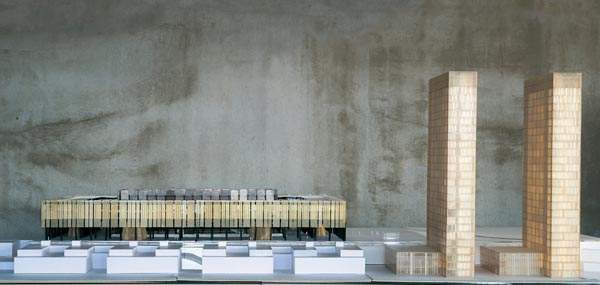
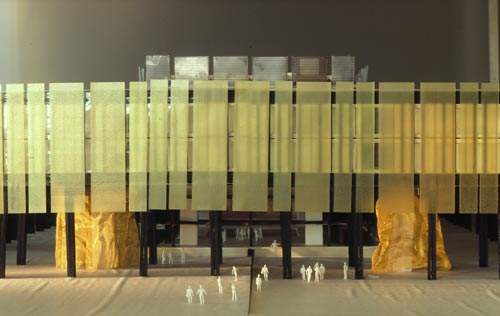
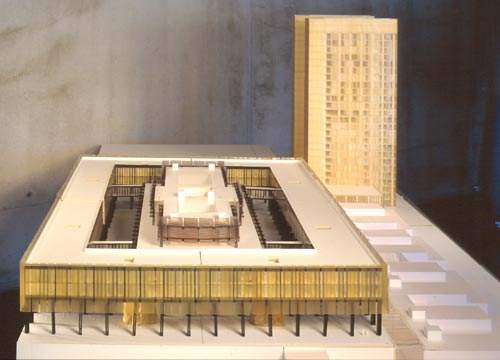
Work on the expanded four-building ECJ complex involved the refurbishment of the main building and construction of a ring-shaped structure encircling the main building (which accommodates the ECJ’s judges and advocates general) as well as two adjacent 105m-high towers with 25 floors in which the translation departments are housed.
The complex is linked by passageways, to which an underground car park was added. The interior of the existing Palais was completely restructured with interior walls knocked through to house the main lobby, the principal courtroom and surrounding courtrooms.
Construction of the two towers created a new urban space which did not exist before, allowing an esplanade through which one can reach the heart of the system.
The orthogonal ring surrounds the first Japanese-style Palais, which has the effect of reinforcing its historical presence with a new mass, with the ring serving as a ‘protection for a historical monument.’
The expansion was designed as to emphasise the presence of the court by the two towers on the Kirchberg plateau, where the city’s EU institutions are located. They are visible from Luxembourg city centre, emphasising the links between the Grand Duchy, the court and other EU bodies.
ECJ expansion builders and contractors
The court project was under the contracting authority of the Administration des Batiments Publics of Luxembourg and was implemented under the supervision of the Public Works Ministry of Luxembourg, in collaboration with the Court of Justice.
The coordinator of the project was Geprolux, the Luxembourg subsidiary of the international turnkey organisation Paul Wurth, and civil engineering was by Gehl, Jacoby et Associés, Schroeder et Associés and TR-Engineering.
The project began in 2003 with the removal of asbestos from the existing buildings and initial excavation works. It was completed in 2008.
The total surface of the site involved is 76,000m², of which about a third is for the translators in the towers. Some 10,500m² is for the offices and premises of the President and court members and 23,000m² for the exterior public space. There are 900 parking places.
Glass was used, according to the architect, not for transparency but to allow light to enter the inside. Hochtief was contracted to construct the outer shell of the building, the plenary and the Anneau.
The roof of the building features solar modules supplied by Kyocera Corporation. The modules have a capacity of 400kWp and generate 360,000kWh annually.
Interior features and contractors
Electrical engineering was by Bevilacqua et Associés, of Luxembourg, which supplied escalators and information and emergency systems, and Felgen et Associés (lighting). Total cost was about €34m.
Jean Schmit Engineering installed heating and cooling equipment, including air conditioning.
This involved the installation of 16 air treatment units and four core water projection engines, each one rated at 1,500kW.
The whole project requires 7,000kW of water-cooling capacity.
Sanitary engineering was contracted to RMC-Consulting of Luxembourg and expert façades to Ralf Rache Engineering.