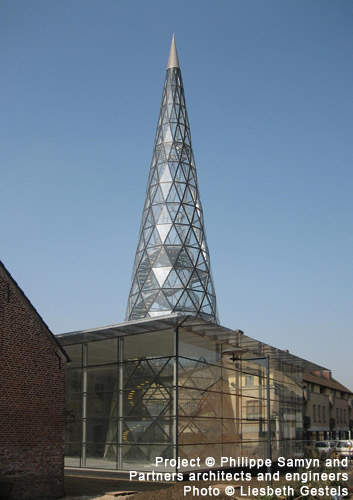

Brussels-based architect Philippe Samyn won the design competition to build this Centre for Contemporary Glass Art, which was completed and opened in the summer of 2006. The building, with its stunning glass cone, was built as an icon for the small town of Lommel, famous for its soil of white sand, with which glass is made.
The House of Glass was not a big project, but is nonetheless worth the detour. A good example of how small projects can put small towns on the map. It doesn’t always have to be about big architecture.
Recommended White Papers
Recommended Buyers Guides

CENTRE FOR CONTEMPORARY GLASS ART
The Centre for Contemporary Glass Art is multifunctional. It wants to inform and educate about glass and glassblowing, for example with interactive workshops, and exhibitions from renowned glass artists. The building’s architecture follows the multiple functions, using glass in varied and innovative ways.
The centre is composed of two interconnected glass areas that interact with each other: first, there is a parallelepiped composed of a stainless steel frame covered with an ultra-clear glass curtain wall; second, there is a glass cone made up of triangles, which clearly identifies the building as the Glass Centre.
The roof is considered to be the fifth facade and will receive a special treatment in the future. The 6m-high parallelepiped houses the exhibition areas, which are laid out on three levels around the cone (the lower level, street level and the first floor).
GLASS CONE
The glass cone, which is 8m in diameter and reaches a height of 30m, dominates the town. It is visible from all directions, but it is not an imposing presence in the urban landscape thanks to its filigree structure and the ultra-clear covering that makes it almost transparent.
At night, the cone stands out as a real landmark thanks to a sea of electroluminescent diodes, as well as its illuminated top. The cone is composed of a unique system whereby the frames themselves make up the many-sided structure, with no other support.
The system is 6cm thick at most and is composed of triangular frames made of hollow steel tubes, to which two stainless steel frames are snap-fitted. The result is a system without joints.
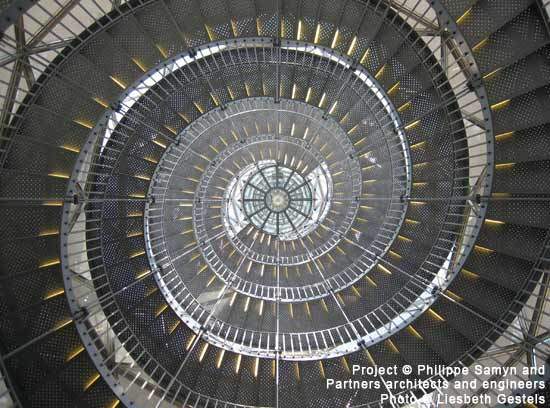
Inside the cone, two identical steel staircases are suspended from the structure and spiral upwards. Ascending the stairs, visitors pass the three exhibition areas, gaining an overview of the entire building.
Interior mirrors have been positioned at ceiling height in the parallelepiped and display an unusual series of reflections of the structure. Even though visitors may be inside, these mirrors enable them to view the entire structure of the outside of the cone by day, and a shimmering light display by night.