
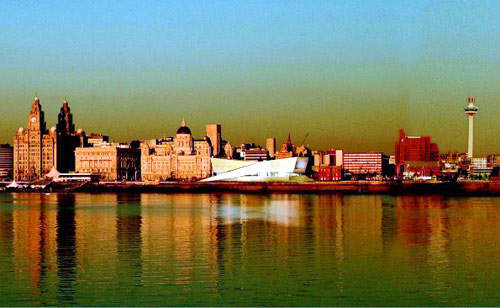
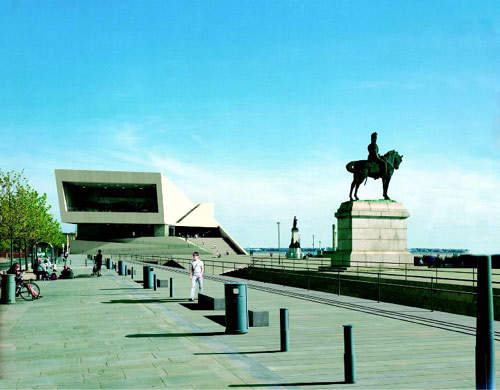
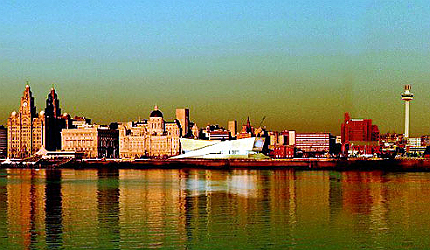
The New Museum of Liverpool is the largest newly built museum in the United Kingdom. It is built at one of the city’s most prominent sites, the listed dock area by the River Mersey, next to ‘The Three Graces’.
Recommended White Papers

Recommended Buyers Guides

The building constitutes inclined or elevated platforms, gradually forming a sculptural iconic structure. All surfaces are accessible; giving way to the public promenade flow along the docks. Situated at the Pier Head, the museum is visible from both the river and the city.
The museum was opened to the public on 19th July 2011. In January 2005 Danish architects 3XN was selected for designing the museum, in a competition against Daniel Libeskind, David Chipperfield, Zaha Hadid and Scandinavian architect Snøhetta.
In 2007 AEW replaced 3XN and was commissioned to submit the detailed design of the project. The architect was changed as the ownership of the museum was changed to New Museum Liverpool.
The estimated investment in building this museum was £72m. It was funded by a number of trusts, individuals, corporate houses and foundations. A theatre is due to open in the museum in 2012.
Structure and galleries of the Museum of Liverpool
The museum building comprises a complex steel frame enveloped by a stone cladding. The free column spaces provided by the steel frame allow the creation of flexible displays in the galleries. There are wide picture windows measuring 8m x 28m at each side of the building. The building covers an area of 110m x 60m. It covers 8,000 square metres of public space spread across three storeys.
The two ends of the museum have large windows measuring 8m x 28m with views of the Pier Head and the river. The architect wanted big windows to allure visitors to the museum.
The museum reflects the regional history of the city. Its galleries were opened in two phases. The first three galleries to be opened were – the Global City, Wondrous Place and the People’s Republic galleries. The new galleries, such as The Great Port, Liverpool Overhead Railway, History Detectives and the City Soldiers, were opened to the public on 2nd December 2011.
The unique facade of the museum is made of Jura limestone. The origami inspired facade prevented the wastage of stone during construction. The spiral staircase inside the museum is another striking feature of the design.
Materials used to construct Liverpool’s museum
The museum’s frame is constructed with 2,100t of steel. The 1,500 square metres of glazing provides a striking view of the city. The facade is clad in 5,700 square metres of natural Jura limestone. About 7,500 cubic metres of concrete and 20t of bolt were used in the construction of the museum. Nearly 20,000 cubic metres of soil was excavated from the construction site.
Sustainability of the museum near the Albert Dock
The museum is constructed with state of art renewal and energy efficient technologies. The combined heat and power system (CHP) installed in the building helps to reduce the carbon footprint by 88.4 tons, therefore saving nearly 88,400 trees.
Liverpool’s emergence as a leading UK city
The city of Liverpool was selected for European Capital of Culture 2008, in which the new museum was a focal point.
For many years, Liverpool has been among the most important cities in the world, and this history is displayed in the museum.
It is one of the world’s leading city history museums, reflecting Liverpool’s global significance through its unique geography, history and culture. The hope is that this new museum will attract at least 750,000 visitors a year, and that Liverpool, with the museum as a lighthouse, can be established as one of the UK’s leading cities .
The visionary building attracts creative forces, generates new agendas and along the way creates a new and attractive image for the city.
Local considerations for Liverpool’s major museum
Related project
Paradise Project, Liverpool, UK
Liverpool has had a chequered reputation in the past but is now set to confound its critics and shine at the heart of the European cultural scene.
Adaptation to the site and a clear distinction between new and existing buildings is essential in a sensitive and listed environment. An architecture style true to its own time is the only way the area’s history stays visible; pastiches which mimic the existing buildings will inevitably obscure the picture.
The distinction is furthermore achieved by using smaller size, lower height and a formal contemporary language.
This makes The Three Graces and Albert Dock stand out and maintain their visual power, while the waterfront maintains its characteristic skyline.
Distinction does not rule out harmony. Harmony is achieved by a balanced use of materials such as a natural stone in keeping with what can already be found in the area, and by planning the new building according to existing public flow lines along the promenade in order not to block any movement patterns. The new building creates protected outdoor spaces and indoor view points towards the city’s attractions.